


DISCLAIMER:
This is a work of fiction. All characters, locations, organizations, and events depicted are either products of the author’s imagination or used in a fictional manner. Any resemblance to real persons, living or dead, or actual events is purely coincidental.
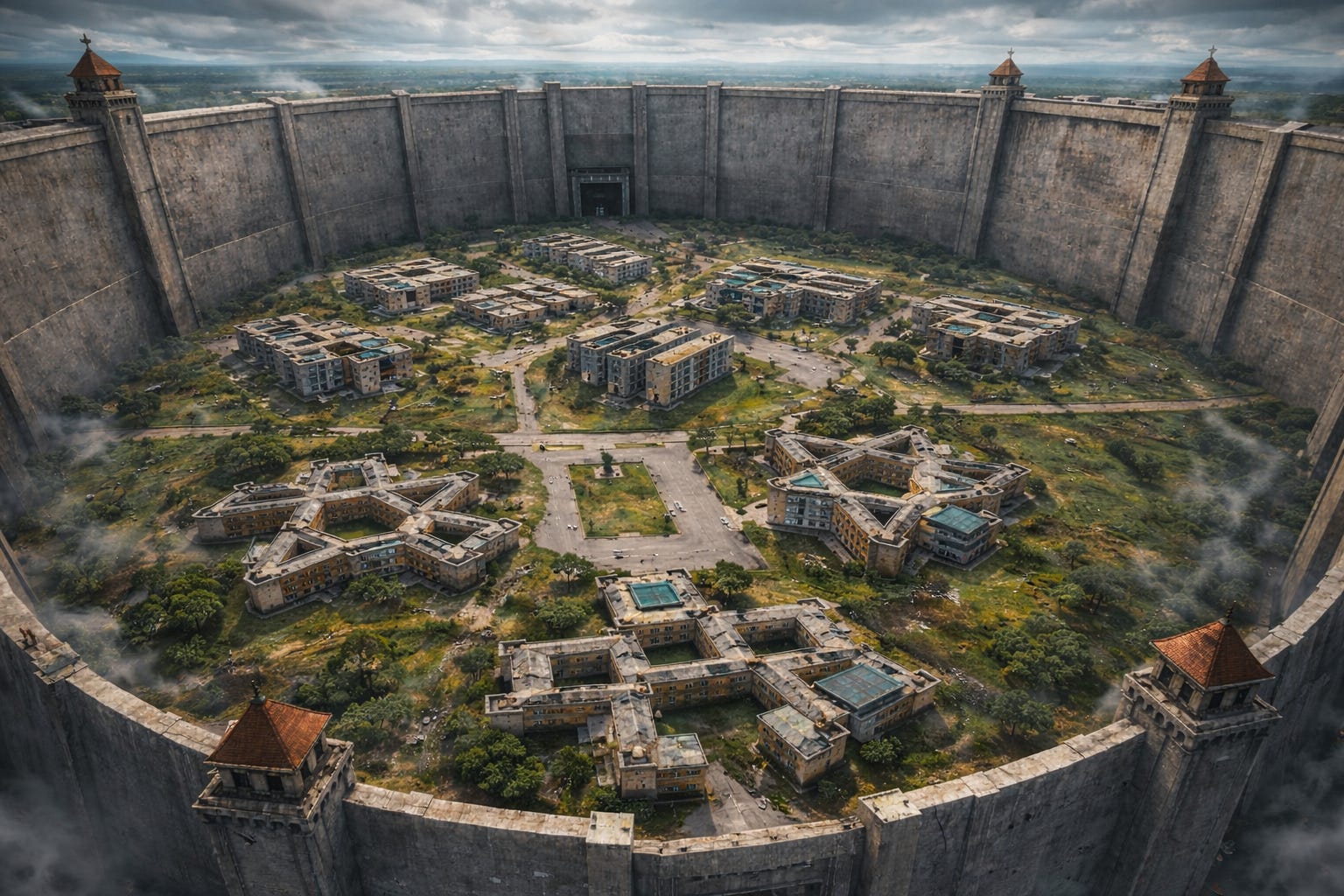
The promise of the Encampment was that it would make us “whole”. At least, that was what they told us. It was what they printed on the brochures, it was what they hung on the signs, and it was what the Officers recited at every orientation assembly or camp-wide gathering.
“All we need is your co-operation in these four years,” they chorused. “Four years and you will emerge refined and prepared as a citizen of genuine worth. A new generation leader.”
Society had decreed attendance at the Encampment mandatory, and because every decent profession required proof of completion, every cycle, thousands of us found ourselves at its gates with our bags and our anxieties. We arrived, signed forms, and essentially handed over the full control of our lives and our well-being to strangers on a council who we did not know.
I wish this story were mostly about me, but it’s not. I survived. I completed my four years, and I left. But there are many others who did not. Many others like Dara. Dara is dead, and there’s nothing I can do about it. Nothing but to tell the story of what happens behind those large, imposing walls.
The first thing they taught us about the Encampment was the Supreme.
The Supreme was not a man but an unseen force that they claimed was the original architect of the Encampment. They said it was by His wisdom the Founders had shaped every rule and every tenet and every waking hour of the four-year programme.
The Founders had been devout men, and their devotion had become the skeleton of the Encampment. It was something you could see and feel everywhere: in the morning calls, in the evening assemblies, in the way the Officers invoked the Supreme’s name before announcing an outrageous policy change, or an intrusive inspection, or an unfair punishment.
The Supreme wasn’t strange to us by any means, but what was strange was the way they presented Him to us. The Supreme was always their reason. The Supreme was their justification. ‘The Supreme’ was, when nothing else would suffice, the only answer they would give.
This was one thing about the way the Officers managed the Encampment that always got us angry, sad, and frustrated. The way they outsourced all the blame and fallout of their bad decisions to the Supreme, like He was the one who made the choices for them.
Why would they never admit their wrongs? Why would they never take responsibility for their actions? Why would they never apologise for their mistakes?
We never understood it, but we hated it. We had no love for Management and we hated the Officers for a lot of things they did to us. Some even resented the Supreme because of the actions of these men.
Maybe the Encampment was built by the Founders due to a genuine desire for formation and flourishing. Many old members from the early cycles speak of their experiences differently. They said the rigour felt purposeful and the strictness had warmth underneath it, and whilst I have no reason to doubt them, that was not the version of the Encampment that I met.
From what I’ve gathered, the Encampment stopped being that way a long, long time ago.
By the time my cohort arrived, the Supreme had become almost nothing but a management tool in the hands of the Officers. We were required to attend the Assemblies of Devotion twice per week at minimum, thrice in certain cycles, four times during the high seasons, and all our attendance was logged. According to the Officers, no excuse could suffice as a reason not to attend. None at all.
If your tally fell below the threshold, you were barred from the Competency Reviews and failure to write or pass the Competency Reviews meant that your four years meant nothing. You would not be able to finish, and you would not leave the Encampment with the credential you came for.
I attended every Assembly the same way most of us did. We would sit in the rows as we listened and let the words pass through us. Many of us became, in this way, very skilled at the performance of belief. Even as we chattered our way through Assemblies, silently hoping for the time to pass away faster, the Management or Officers never seemed to care. As long as they had us all gathered when we were supposed to be, they seemed to be content.
I never understood it. If the Supreme were as powerful and important to our lives as they claimed He was, why were they more concerned with using Him to control us than with us actually understanding His ways? It never made sense to me.
The most obvious expression of Management’s desire for total control was a division within the Encampment known as the Enforcement and Regulation Forces or the ERF.
The ERF’s stated function was to maintain order, to uphold the Encampment’s Code of Conduct, and to ensure that all members were adhering to the standards of dressing, behaviour, and schedule that the programme required. I do not pretend that their presence was not necessary, as I know that some degree of structure is always required for any communal institution to operate in sanity.
However, when it came to the ERF, their power operated with almost no form of accountability.
They moved menacingly through the compound in pairs, sometimes in groups, and they had absolute authority to detain and to report and to recommend punishment. The Code of Conduct gave them a wide latitude for both direct and indirect oppression, and they used it as much as they could.
A member wearing the wrong shade of clothing could be stopped, documented, and sanctioned. A member walking unescorted in certain areas after certain hours could be detained for the remainder of the evening. A member who spoke too plainly to an Officer could find himself or herself reviewed, then restricted, and then isolated for a period of time.
Some of the ERF officers were simply rigid, or heartless, as many members described them. They were people who had internalised the Code so thoroughly that they had lost the ability to distinguish between its letter and its spirit. They had no empathy within them, and it was as if they had found the perfect opportunity to unleash the malice buried deep within their hearts. An opportunity they took advantage of every chance that they got.
There were other Officers too, those who accepted bribes. Small things at first, like a fee paid in exchange for a warning not becoming a formal report, or a favour exchanged for a blind eye. It was understood by both Officers and members, but it was never directly acknowledged. Many even believed that Management sometimes had a part to play in this corruption but barely ever spoke loudly about it.
The Encampment had created a system of enforcement without oversight, and systems without oversight tend to find their own economies and end up operating beyond their confines. It broke my heart to hear that while Dara was dying in her residential block, somewhere in the compound, ERF officers were inspecting the hemlines of members.
I’m trying to concentrate as I write this, but I keep tearing up because of Dara. My dear friend, Dara. The one who died within the very walls of the Encampment.
Dara was not the first of her kind, as there have been many others before her. Many lost their lives in the Encampment because the very people and facilities that were meant to save them fell short of their duty.
I blame the Medical Unit of the Encampment for the death of my friend.
There are ten residential blocks in that compound. Ten buildings, housing somewhere between three hundred and eight hundred members each, depending on the cycle and depending on how crowded Management had allowed things to become. Of these ten blocks, not a single one has ever contained a treatment bay or a trained medical attendant that was stationed overnight. There were basic kits with tin boxes, antiseptic rubs, and some bandages, but considering the type of illnesses and health dangers we faced, those things could never do anything to help us in times of need.
There was one medical vehicle, just a single transport that was used by the entire Encampment, which meant it was shared by the thousands of people living, working, and sleeping in that compound.
In the event of a medical emergency, the procedure was for members to find a way to get themselves to the Medical Unit office or to alert the nearest Officer, who would then alert the Unit, which would dispatch the vehicle if the vehicle was available and if the driver was reachable and if enough time had not already passed for the situation to become irreversible.
In my first year, a member that lived two blocks away from mine went into a sudden crisis in the middle of the night. They said it went from fever to convulsions and then to stillness and that he stayed that way, unconscious on the ground, for a long time until the vehicle arrived eventually. They rushed him and whatever life that was left in him to the Medical Unit, but he did not survive. He had already died. We heard about this story the same way we heard about most negative things that happened in the Encampment, through whispers and through the gatherings of different fragmented stories.
Management released a statement about the death, and it came as a surprise to us all because they never publicly acknowledged events like that. What was unsurprising, however, was the nature of the statement. Whilst they expressed their “sorrow” and their “support” for his family members, they did not mention the forty-minute delay, and they took no responsibility for his death. As always, they downplayed the role of their negligence, and they did all they could to prevent the news from spreading too far beyond the walls of the Encampment.
The following year, another member died. Then the year after that, and the year after that. Each time, Management would either ignore it or put out a statement, but every time, they made no further changes. Those deaths, as painful and sad as they were to hear about, always seemed like they were happening in a floating, parallel reality until my friend, Dara, died.
By the time Dara died, I had already left the Encampment. I heard about it through someone who had heard about it through someone else, the news travelling the way bad news does in that place, reluctantly and in pieces. Dara was in her final year, and they told me that she had complained of pain in her abdomen for two whole days before she collapsed, but the Officers in the Medical Unit had dismissed her complaints.
Her friends had done everything within their means to help her, but it was not enough. Of course it wasn’t, because saving her life had never been their responsibility in the first place.
Maybe these things would make more sense if all parts of the Encampment were abandoned by Management to rot, but they weren’t. In fact, many other aspects got more attention than the parts that we, the members, deemed were more critical to our survival.
It was near the end of my second year that I first noticed the cameras. They appeared gradually across the compound – above the entrances to the residential blocks, along the main walkways, and at the corners of the Assembly Hall, the administrative buildings, and the dining facilities. They were small and dark and steady, with their blinking lenses pointing outward in all directions.
We didn’t need an invoice to know that Management had invested substantially in this infrastructure. We didn’t need a memorandum to know that the cameras were networked and that someone, somewhere, was watching us all the time. We didn’t need an explanation to know why.
I thought about this for a long time too, and I tried to understand the logic behind it.
If you claimed the Encampment’s purpose was formation, the genuine development of its members, then you should be more concerned with investing in other critical things. Like the outdated and incompetent Medical Unit, for example. You would ensure that the people in your care would not keep dying from preventable causes. You would build structures that kept them safe, and healthy, and capable of growing into the leaders you claimed to be forming. You would not be building a surveillance network of total control.
But, of course, formation was not the primary goal. It was something else, something they would never ever admit out loud.
Over the years, we have had different members who tried to speak out, both internally and externally, against the ills that went on in the Encampment.
In my third year, a group drafted a formal complaint about the Medical Unit’s failures that was detailed, documented, and signed anonymously by over two hundred members. They followed all the due processes and submitted it through the official channels, but the complaint was never formally acknowledged, and the following week two of the lead drafters were placed on disciplinary review.
A former member of the Encampment who was several cycles ahead of mine published an account of her experiences a few years after she left. She had been careful to be specific in her claims, restrained in her language, and scrupulous about documentation. Unsurprisingly, her work went viral on the internet, and it sparked a lot of outrage from people in society as they called for different forms of justice and external intervention.
However, the response of Management was to engage legal representatives, and the woman was served with different letters threatening judicial action. Before anybody knew what was happening, she redacted her claims, deleted all traces of her work, and her social channels fell into total radio silence. They’ve been that way ever since then.
If there’s one thing I know about Management, it’s that they place a high premium on the reputation of the Encampment being spotless, even when the threats to it are justified. And with the threat of sanctions constantly hanging over the heads of current members and their unlimited resources to take legal action against past members, it’s no wonder you barely ever find anybody speaking out.
Even whilst the losses and the inhumane actions continue to pile up.
I have been asked, since leaving the Encampment, whether I believe at all in the Supreme. It is a complicated question to answer, but I believe that I do. I believe that the Supreme is not who was shown to us in our time. What was shown to us was a version of the Supreme that happened to be convenient for the people in charge. A version that Management and the Officers could use as a justification for their excesses and inactions.
Many members, including friends of mine, have left the Encampment with a profound and unresolvable coldness toward the Supreme and everything associated with Him. I understand this, and even though I believe the coldness is being directed in the wrong manner, it’s not hard for me to understand why they carry such sentiment.
When something has been used to cause you harm and when it has been the instrument of your silencing and your coercion, it becomes difficult to approach it with anything other than suspicion.
This is what the Encampment and its Management did to the belief of many in the Supreme and I believe it is very shameful that this is the testimony of thousands of past and current members about that place.
Dara is dead, and I am writing this from a room far from the Encampment’s walls. I do not know who will read it, but I am not naive enough to believe that these words will change anything.
I know that the Encampment will still wax on stronger. Management will continue, and the ERF will continue. More charges will appear in the portals, and the Assembly Halls will be filled with more and more members performing belief. And the most unfortunate of all is that, somewhere, one day, because of the Medical Unit’s overall negligence, another person will run out of time.
It breaks my heart. However, I also know this: the Encampment is not inevitable.
It was built by people who made choices, and it continues this way because people continue to make those choices. I was inside those walls for four years, so I know how permanent and trapping they feel from within, but I am outside now, and from out here, I can see that they have edges. I can see the cracks slowly starting to form.
Dara deserved to leave through the front gate. She was owed that. She was owed it by every invocation of the Supreme’s name, by every Assembly she sat through, by every charge she paid, and by every day she spent within those walls. Dara is owed a reckoning.
I will not pretend that I know when it will come; after all, I have learnt not to make promises about timing. But I have also learnt that institutions do not fall from the outside but from the inside. They hollow from within, quietly, from all the compromises they could not afford and made anyway, and one day – one day – the entire façade of the Encampment will fall and be revealed for what it truly is.
I will be here when that day comes, the same way I have been here all along.
Sounds like a very familiar place to me…
Anyways, this week on Ebun Speaks-
Follow the page so you never miss a new episode every Friday.
READ NEXT-

Sounds like a very familiar place to me too😞😞😔